The Machine
What the controls actually do, what the spec sheet means for you, and which noises to take seriously.
Lessons 1–10First Edition · 2026 · Volume I
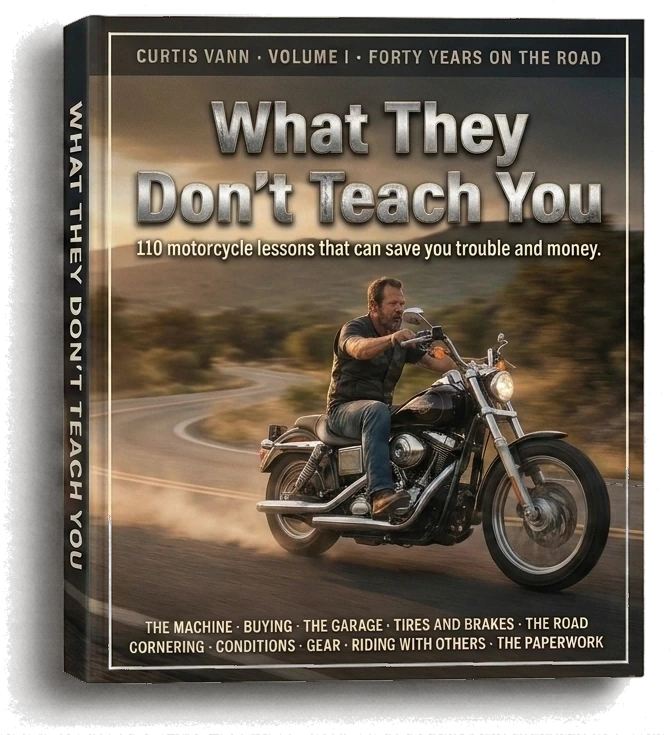
110 motorcycle lessons that can save you trouble and money.
Forty years and four hundred thousand miles, written down one page at a time. Not freedom and the open road — the small, specific, unglamorous things that decide whether riding stays cheap and enjoyable or turns into a run of expensive surprises.
The book
The safety course teaches you to operate the machine, and it does that well. Take it. But the course is two days long and it ends at the parking lot gate.
The dealer teaches you what is good for the dealer. The owner manual is written by lawyers and tells you the truth in a language designed not to be read. The forums will argue with you for six pages and settle nothing.
In between all of that sits the working knowledge of riders who have been at it a long time — and it gets handed down one piece at a time, if you happen to be standing near the right person. Most people never are.
So I wrote it down. — Curtis Vann
When something is settled, it says so plainly. When it is Curtis's preference, it says that. When riders genuinely disagree, you get both sides — and which one he rides by.
Deliberate. Open it at a red light's worth of time, read one, close it, and have gotten something out of it. Every lesson ends with a bold line — the part to remember.
Drawn plain on purpose. Where a diagram helps more than words, there is a diagram — meant to be understood, not admired.
Chain slack, tire pressure, torque, service intervals. Every figure is the common range, so you know when something is badly out of line.
What's inside
You do not have to read it in order. The parts are grouped so you can go straight to whatever is on your mind this week.
What the controls actually do, what the spec sheet means for you, and which noises to take seriously.
Lessons 1–10The bikes to walk away from, cold starts, date codes, salvage titles, and what a motorcycle actually costs per year.
Lessons 11–20The tools that cover most of it, your own oil, chain slack measured properly, torque figures, and which jobs to hand over.
Lessons 21–30Pressures, wear patterns, threshold braking, the surfaces that take riders down, and fixing a flat on the road.
Lessons 31–40The car turning left across you, four-second gaps, blind crests, deer, and the intersection routine.
Lessons 41–50Slow in, fast out. One steering input per corner. Trail braking explained honestly. Gravel on the exit.
Lessons 51–60Cold tires, wind, riding within your headlight, fuel range, packing, and knowing when to stop for the day.
Lessons 61–70Read the certification, not the price. What actually protects you in a slide — and what gear is really theatre.
Lessons 71–80Staggered, not side by side. The group rules nobody says out loud, and the rider you should not ride with.
Lessons 81–90Traffic stops, what insurance does not cover, titles, theft, and the real cost of a cheap repair.
Lessons 91–100What changes after fifty, coming back after years away, the first ride of the season, and staying at this.
Lessons 101–110137 pages, delivered as a PDF the moment you buy.
Get the book — $27Read a page
Most new riders are taught that the front brake does the stopping and the rear brake is there in case. That is roughly half true, and it leaves out the half that matters.
The rear brake has three jobs the front cannot do at all: steadying the bike at walking pace, settling the chassis before you tip in, and holding you on a hill with your right hand free for the throttle.
Stop treating the rear brake as an emergency item and half of low-speed riding gets easier.
A motorcycle goes where the rider looks. Not roughly — precisely. Fix your eyes on the pothole and you will hit the pothole.
A rider enters a bend a little hot, decides they are not going to make it, and locks their eyes on the outside edge of the road. Everything after that is their body obeying their eyes. The bike almost always had lean angle left.
Look at the gap you intend to use, and press the bar toward the gap.
Tread depth tells you how much a tire has been used. The date code tells you whether it is still a tire at all.
Rubber ages whether the bike moves or not. A low-mileage bargain sitting on eight-year-old tires is a bike that needs two tires before it needs anything else — and that is money off the asking price.
Check the four digits before you check the tread.
Excerpts condensed from the first edition. Each of the 110 lessons runs a single page.
 Curtis Vann · Volume I
First edition · Instant download
110 motorcycle lessons that can save you trouble and money.
Checkout handled by Gumroad. Your download link arrives by email straight after purchase.
Questions
A 137-page illustrated PDF. You buy through Gumroad and the download link is yours immediately — no shipping, no waiting. Read it on a phone, a tablet, a laptop, or print the pages you want and leave them in the garage.
Part of it is. Most of it is not. The lessons on buying, storage, tire dates, insurance, paperwork, group riding and what changes after fifty are aimed squarely at riders who already have miles behind them. New riders should still take a certified course — the book says so on page one.
The videos cover one thing at a time and then they scroll away. This is the whole set, in order, indexed, one lesson to a page — sitting on your phone in the garage at the moment you actually need it. If the videos are enough for you, keep watching them. They are not going anywhere.
Because it is a PDF. No printing, no shipping, no shop taking a cut. The number that matters is the other one: an hour of dealer labor costs more than this book, and there are lessons in here — the tire date code, the cold-start check, the corner entered right — that are worth a great deal more than an hour of labor.
Yes. The lessons are about riding, buying, maintaining and surviving on two wheels — cruiser, sport, touring, adventure or standard. Where a figure depends on the machine, the book gives the common range and tells you to check your own manual, which outranks it every time.
No, and it does not pretend to be. It is informational and educational — not a substitute for your owner manual, a certified course, or a qualified mechanic. Where the book tells you to stop and call a professional, stop and call a professional.
No. The eleven parts are grouped so you can go straight to whatever is on your mind this week. Where one lesson depends on another, it points you to it by number.
Yes — Gumroad has a gift option at checkout. It is a good one for a new rider in the family, or for the friend who just bought something with more horsepower than sense.
Wait — one thing
Forty years of it, written down, one page at a time. One lesson in here — a date code you read before you bought, a corner you entered right — pays for the whole book several times over.
Get the book — $27Instant download · yours forever
or see what's inside →